
If you are looking for technical writing, you may want to skip this.
Introduction:
Long before I saw my first physics equation or touched a computer, writing brought pleasure. Not just putting words on the page, but writing what others want to read. I found this very difficult. Coding, physics and math, while not easy, were considerably easier and gave just as much pleasure. Financially speaking, the latter path seemed more viable.
However, the itch never left. As a physicist, I had to write a lot. But writing scientific papers, proposals, progress reports, presentations, and code is not writing. Nor should it be.
Not to give away the ending, but a series of events allowed me to scratch this itch. They say write what you know. Since I did not want to ‘pollute’ this blog, I turned to LinkedIn. This had an added benefit that each Part and Epilogue had to be 3,000 characters or less. To my surprise, the result was better than I expected, given the narrow scope. From the first to the last, this took a few months. I decided to archive the series here.
Part 1
So, you want to be a physicist?
Don’t. Really. Don’t. You can make a decent living with Ph.D., but there are much easier and more lucrative ways. You avoid a ton of courses, mountains of homework, nearly impossible exams, constant weeding all while your office/lab is in a basement. “I’m a physicist” has never worked in attracting a mate. Utter those words in public, the conversation will grind to a halt. Or you will be informed that Einstein/QM/… is wrong. And why. No win here.
Not enough? True story to show you how Kafka-like your life will be.
After my second year at GE Global Research (a.k.a. Corporate Research), I was ‘percolation’ or ‘electromagnetism’ simulation guy. Former for gas and electrical transport through porous medium and the latter for creating efficient incandescent lightbulbs (the latter failed, different story).
One morning I got an urgent phone call from a fellow researcher. His proposal for government research grant was rejected. They were going to talk to the agency to understand why. He wanted me there. At GE, only managers get to say “no”. I said sure. Send me a charge number, the proposal and the time/number to dial into. He did and I dived in.
Apparently the government was looking for protection suit against directed energy weapons. The way it was presented was some microwave device that could be directed at crowds for crowd control. You can imagine how uncomfortable being hit with microwaves would be. Ergo, protection suit for individuals. Straight forward. Understood why I was asked.
I then read what GE had proposed. Lots of graphs about skin depths and frequency dependancy, meta-structures, etc.. All nicely polished and looked great. Eventually I found the key proposal. The suit would block radiation by absorption. I had to read that twice.
I quickly dialed in, saying “Cancel the call”. “Why?” “Garbage”. Silence. Then a click of the agent connecting. The guy seemed jovial enough. GE thanked him for his time and had requested this call for clarification on why the proposal was rejected.
After hesitating, the guy said something like “You propose to absorb the radiation?”. GE responded with an enthusiastic “Yes!”. Bit more delay. “You’re going to turn him into popcorn?”
“Ha!” I cackled. Involuntarily, I assure you. GE response was dead silence. Researcher said my name. “Yes. I agree.”. That particular researcher never talked to me again, but eventually nicknamed me Reaper (yet another story). Regardless of the quality of people around you, and there were very good people at GE, it doesn’t stop the absurdity. Went from excited for the days work to upsetting a colleague and questioning if this was the right place. All before lunch. Deal with it.
In case you’re a bit confused. GE was right, such a suit would protect the wearer from microwave radiation. However absorbing the radiation means also absorbing its power. Which would increase the suit temperature, continuously.
Still want to be a physicist?
Part 2

So, you want to be a physicist?
Don’t. Really. Don’t. You’ll end up in a lab. Government means Q-classified physics and WMD. Industry means making coin.
By end of second year at Seagate Research in Pittsburgh, I was ‘simulation guy’. Director was a former CMU prof/IBMer who hired young Ph.D.s and industry veterans. Range of simulations was great. Colleagues mostly bright and eager. Joy.
Our main mission was a PMR prototype. It was not going well. Lab demos proved feasibility, but far from a prototype. Nothing worked. Heads bad. Media worse. Signals broke channels. Mood was low.
Simulations plateaued too. Correctly. We missed two things: used a single-pole writer and media lacked what IBM would call ’pixie dust’. No one knew.
Review was coming up. Polishing the presentation in my basement (again, a basement), even I found it sad. I avoided the Center, being the opposite of a multitasker, switching is hard. Much more productive in the basement.
LLG is the main equation for (micro)magnetics. Precession and damping. Landau added damping. Gilbert changed it. It was ad-hoc. Therefore suspect. Despised it.
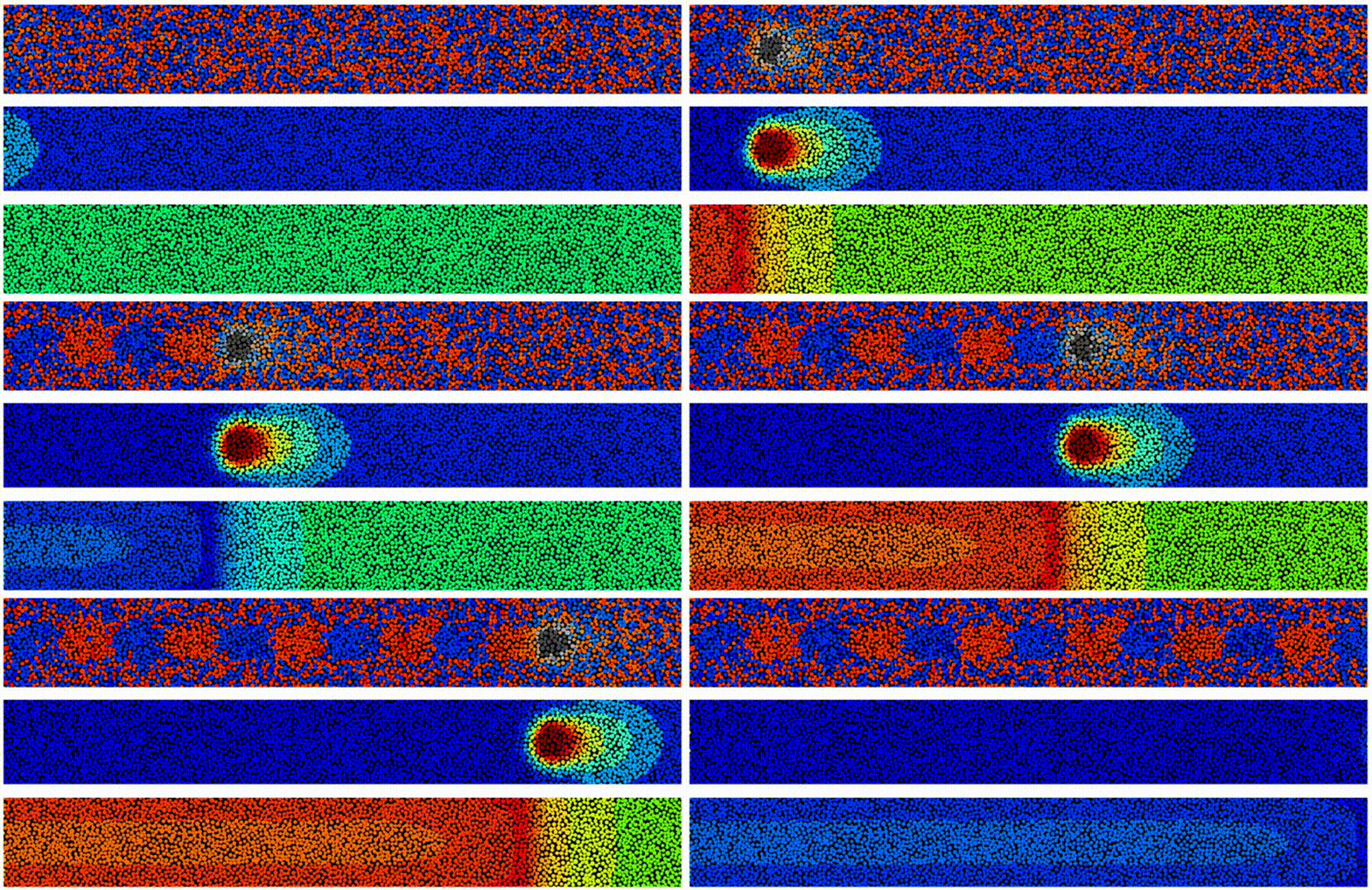
I cast the equation into spherical coordinates. Threw away damping. It was analytic if the field was in-plane and always perpendicular to the magnetic moment! It flipped spins linearly in time and field. I didn’t believe it. Rederived it. Puzzled. Coded it up. Watching spins flip with a tiny field, I still didn’t believe it. Reversing field rotation, spins flipped back. I stayed up all night trying to poke a hole in it.
No time left. Threw in an extra slide. It had equations. Never good for a review. Showered, dressed and drove to the Center.
Gave the presentation, admitting PMR results, well, sucked. Mood sank. “But, I did find something else”, I chirped. Threw up the slide. Few followed me. “I know this doesn’t make sense. But look, I’m going to run this exact simulation right now. Just watch the graphics”.
Ran it. All grains flipped quickly and in unison. “And it works in reverse.” It did. “Look at the time it took and the field applied!” Put it in a loop and let them watch.
Silence means failure after a presentation. This time, first a rustle through the auditorium. Then whispers. Then everyone talked. I was focused on one. The Director was sitting straight up, mouth slightly open, watching. Eventually, he slowly shook his head “No”.
The Director cleared his throat. Silence descended. “I don’t think that works”. I smiled. “If you believe LLG works, then you believe this.” Bedlam. To his credit, he allowed a group to play with it. Never got far; a localized rotating field is hard. It evolved into pulses down transmission lines. By then I was at GE.
The idea was crap. But the mood improved. Eventually, the industry called it MAMR. I showed an ideal implementation. Plato approved.
Because of this curiosity, I would have to resign 17 years later. At a different company. A different story.
Kafka.
Still want to be a physicist?
Part 3
So, you want to be a physicist?
Don’t. Really. Don’t. If you do, you’ll get a shiny new Ph.D. Congratulations. It wasn’t easy. When told I passed my dissertation defense, convinced something was broken. I knew nothing of significance.
Lev Landau ranked physicists on a logarithmic scale. From 0 to 5. Newton a 0, Einstein a 0.5, and founders of QM (Bohr, Dirac, Bose, …) are 1. He ranked himself a 2. Us normal physicists are clustered near 5. Instead of logarithms, think aquatic species. We are krill. Landau a tuna. Dirac a shark. Einstein a blue whale and Newton a leviathan. Alas, I’ld be happy as a clownfish, yet a krill it is.
If you don’t swim in the ocean, the size is limited. A krill is big in a puddle. Being born in one, I was big. Left for a lake called UW-Madison. I was the same, but much smaller. LLNL showed me how small I truly was. It is humbling. Bit scary. It will happen over and over. Accept it. Just swim.
The funny thing is, even the big fish watch small fry. A great thing about physics. If work or idea or question has merit, the whales pay attention to a krill. They know, as you will, a missing piece can appear anywhere. Anytime.
The size isn’t determined by school or advisor. A big fish for advisor increases your network. Maybe a good thesis too. Otherwise, it’s irrelevant. Known a few from top schools with complete lack of physics intuition. Know others, from nowhere, who asked the key question or found a piece. R^2 ~ 0. Again, it’s the merit, not the who. At least eventually. As everywhere, there are charlatans, prima donnas, plankton and foraminifera. Deal with it. The work is what matters. It’s the only thing. Rest is noise.
My first presentation as post-doc at LLNL was 10 minutes. The discussion following went on for 45. The first 5, the results were scrutinized, questioned and challenged. Fortunately, I had sufficient answers. The next 15 was meaning and ramifications going forward. The rest, a litany of routes to explore. Honestly, I understood maybe half. Grew a micron.
Being constantly confused and constantly questioning your work is the career. You’ll spend most of your career thinking about problems not solved. Often questioning if it is solvable. If solved, you’ll forget it. A new one is waiting. If not solved, it will stay with you. Forever.
Gods forbid if your pond makes you big. Leave the pond. King of krill is useless. Wasted potential. Look for a pond that makes you small. Swim with bigger. Strive to keep up. Find a missing piece. If you fail, no one expected much from a krill. If you’re lucky, might graduate from krill. Regardless, the whales will know what to do with the piece, if you don’t.
Don’t expect much. Sure, there will be awards, invitations, patents, papers, bonuses, stocks and salary adjustments. All are fleeting. Soon you’ll be back in a basement, suspecting you know nothing of significance. Again. It’s the work. Only that.
Still want to be a physicist?
#Physics #Research
Part 4

So, you want to be a physicist?
Don’t. Really. Don’t. You’ll find yourself in a lab, likely basement. The reason is some org. Orgs come in all shapes and sizes. All share a sole purpose. Growth.
“What company?! We are the company!” manager berated. His point, I missed, is there is no “company”. It is people. Game theory. Non-cooperative, simultaneous, unknown rules. Compound intent. Often blind. If physics is hard, org is NEXPSPACE.
Org’s direct effect is salary adjustment and basement provision. Latter is contingent. At will. Watching tears because a project lead needed a scapegoat. Power plays for control. Petty grievances ending a career. Org will crush anyone. Even whales.
Academic orgs have passionate arguments about small things. Search for funds and good students.
Government orgs have passionate arguments about physics. Then scramble until next funding cycle. Ph.D. required for org chart. Byzantine construction to constrain physicists. Requires Congress working.
Business orgs have passionate arguments about widgets. Get widget part. Make widget. Sell widget.
Research orgs have passionate arguments about resources and people. Where resources originate is key. One or more buckets.
GE had three buckets: business, government and CEO orgs. The largest was business. Corporate would ‘tax’ each business unit to fund Research. Budget fixed, who and what up to business. GE businesses are efficient taskmasters. Hard deliverables, no guarantee of continuing. Slog.
Government buckets had easier metrics, often multi-year. Unlikely to fail. Difficult to get. Congress again.
Coveted bucket was CEO. GE called it AT. It’s whatever the CEO office dreams. Only metric is continued funding. In first meeting with manager, he made it clear he wanted that bucket. His lab had only business bucket. I said, ok.
Two projects first year. CFD for reverse osmosis (different story) and modeling for fuel cells. Simulate gas, electron and ion transport through a tri-phase microstructure. GE required new people to do a 6-sigma/DOE project. Derived percolation limits and calculated the effective diffusivity and conductivities as a function of microstructure. All 6-sigma’d up. Polished. Director loved it. Director was close to VP. Suggested an AT project. Manager was happy. Soon AT projects with lab cohorts. Manager very happy. Initially projects were easy. Simply impossible.
Once whatever simulation was done, conclusion was easy. VP was happy. Could do other CEO dreams. I was happy with breadth of physics. Manager happiest. Reaper not welcomed when assigned to your AT project. Eventually, a quasi-comfortable equilibrium reached. Most impossible projects gone. A few sacred cows.
VP left suddenly. Taking Director. Manager championed a promotion to consolidate power. Not merit. Org realigned. I was labeled ‘difficult’. Another story.
Org not solvable. Utterly fascinating. Huge time sink. Little gain. Ride.
Still want to be a physicist? #Physics #Research
Part 5
So, you want to be a physicist?
Don’t. Really. Don’t. Even with a Ph.D., you’ll have a manager. A manager will tell you what to do. You will need to do it. If you want more freedom, you need to demonstrate higher value work. Such work can be found by talking to colleagues and looking for common problems.
Managers come in all types. Most are harmless. Others enablers. Few golden. Then there are horrid.
Horrid know/suspect they are imposters. If they talk more about themselves than work, you have one. They may present your work as theirs. Usual scientific integrity is lacking. They will self-destruct/be replaced, just keep clear of blast radius.
Clueless are a subclass. Either not aware of org’s game theory or think they are masters. The former means they are pawns. Manipulated by others for some purpose. Latter are simply delusional. Actively replace either.
Hens are another subclass. In addition to what to do, they will tell you how. You didn’t get a Ph.D. to be told how. Lack of trust will destroy the relationship.
Mostly harmless rarely do anything that attract attention. Including salary adjustments. Vesting and/or retirement motive. Help them hide. Don’t expect help.
Enablers will actually be effective managers. They will advocate for resources and recognition, reduce b.s. from above. They typically will ride your successes. May think it is theirs.
Golden take a risk on you, usually because of your work. Complementary ones are mutual symbiosis. Stick with those. In either case, must be rewarded.
Progress reports and performance reviews involve manager. One builds on the other. Performance reviews don’t mean much other than salary adjustments. Ignore positive, look for missed performance and ‘insubordination’ and ilk. Must be addressed. Priority to fix.
Something like “Greg willingly takes on new projects, even if not previously familiar, and within months complete 80%…”. So, I never finished anything. Manager was taken aback by my aggressive challenge to the characterization. “No. It’s good. You know not to waste time chasing the last 20%”.
Or “You are not as good as you think you are” which is funny when you’re a krill and they are a plankton thinking they are a shark.
Others’ manager can be asset. Some are territorial. First month at HGST, sitting in the back for a meeting to start, for a project not assigned. Just curious. Looking for low hanging fruit or common roadblocks. Leader, IBM holdout and perhaps a sunfish, “I see we have a visitor today.” and looked directly at me. Think I stuttered “I can leave”. He then started the meeting in usual manner.
One can manage oneself. Called consulting/own org. Different story.
You can become a manager. This usually means doing less work and trying to manage cats. Different skill set.
Managers are mandatory. By decree. Manage and polish them. Mostly useless. If you want success go beyond their limited vision. Deal with it.
Still want to be a physicist? #Physics #Research
Part 6

So, you want to be a physicist?
Don’t. Really. Don’t. Not only being constantly confused and constantly questioning your work is your natural state, probably in a basement, but often you question sanity. Yours or the world. Usually both.
Your Ph.D. will equip you with a lot of mathematics and approaches to physics. You’ll learn how to reduce the most complicated problem into small problems which are solvable and then put them all back together. It’s all quite hard, challenging and, well, fun. Some will take just a few minutes. Others take a few decades. The reward is the journey. Then the next problem is waiting. Regardless, Nobel is not going to call. Most likely.
Poincaré said the best way to solve a problem is to throw anything and everything on the table. Even ridiculous ideas. Then you use logic to throw away the nonsense. If anything survives, that is your starting point. The corollary is it is more important not to be wrong than to be correct. Therefore, setting aside all the math and physics, logic is the most useful tool. Propositional, first-order, whatever logic. Truth table and Venn diagram. Gödel showed that logic (well any formal system) has statements that are true but unprovable. Doesn’t matter. If you can show a contradiction, then you know at least one of your premises is wrong or the problem is unsolvable. Seen people waste time trying to solve unsolvable problems. Time is limited. Wasting it on such problems is a contradiction.
Another problem with becoming a physicist is rarely discussed. Everything is a problem. A gorgeous sunset dissolves into Mie/Rayleigh scattering, phase diagram, and Naiver-Stokes. Ocean waves are non-linear waves and dispersion relation. A walk through a forest is refraction of light and how sounds are attenuated. Watching kids build sand castles becomes estimating critical angles and how wetted particulates stick together. Campfires dissolve into combustion equations, heat transport, particulate transport and Mie scattering. Doing dishes becomes bubble dynamics. Eventually someone asks what’s wrong. You either tell them what you’re thinking or say “Nothing”. Either way, they think you’re insane. Or worse.
Of course, most sci-fi books/movies are too painful. You will burst out laughing during a tense moment only to have those around you becoming annoyed. More so if you explain.
Let me be clear. You cannot stop doing this. And it is not limited to just physics. You will analyze your partner, kids, cat, parents, coworkers, other drivers, strangers, everything. “You never know what is going on inside someone’s head” an advisor once told me. True. But it doesn’t stop you.
“Main purpose of Physics Departments at research universities is to provide physicists for the national labs.” another adviser told me after I turned down a staff position at LLNL. He then offered the single most useful bit of advice: “There is always room at the top.”
Still want to be a physicist? #Physics #Research
Part 7
So, you want to be a physicist?
Don’t. Really. Don’t. As in any human endeavor, you expect to pay a price. Four years as undergraduate and another four (or more) to grab the Ph.D. was the price I accepted. No one told me that was just the admission price.
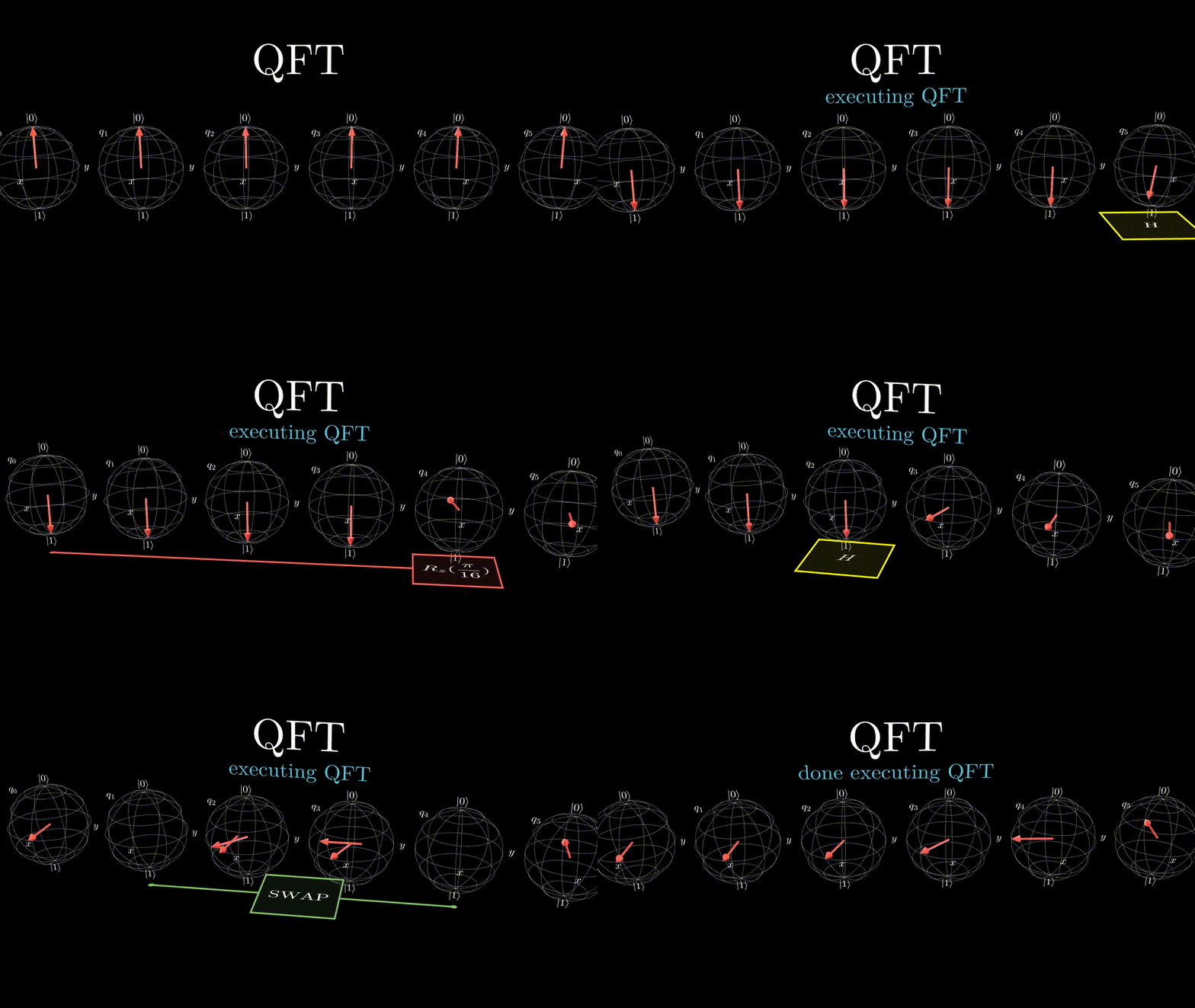
In 1974 Richard Feynman gave the commencement address at Caltech called “Cargo Cult Science”. Speech meanders, but contains truths. First read, I had to read it twice. Sinking feeling was real. But I heard his clarion call. It rang true. Came to the same conclusion as a child.
Integrity is key. Say what you did. Say what you’ll do. Answer all questions. Point out the flaws in your own work. Hope someone, anyone, can poke a hole in it. If you pass that gauntlet, then maybe, just maybe, you touched what Einstein called “the secret of the ‘old one’”. Turns out, this is the easy part.
Physicists range from plankton to whales. But scale is irrelevant since all are human. Greed, jealousy, ego, power … come with all humans. These are not checked by the door after paying the price of admission.
How many times was a manager included on a manuscript they had no contribution to? How many times did an executive take credit and an award for an impossible engineering task simply because he ‘approved’ it? How many times was someone hired based on recognition and not merit? Why can a promotion be based on who you know and not what you know? Why do resources not align with stated goals?
Why is data easily accepted because it looks good? Why is pointing out a flaw viewed as a flaw? Why is it better to follow than to search? How does PR dictate physics? When did compliance outweigh truth? How does a title become the overriding factor? How long are resources, and time, wasted on nonsense?
This is the real price. A price to be extracted.
“Shelf life of seven years” one colleague diagnosed me as. That’s about right. After seven years in an org, I’m presented a choice. Shut up and take the check or leave. I leave else Feynman’s clarion is ignored. The hard part here, you probably have a family depending on you.
“What is wrong with you?” I’ve been asked too many times. Am I the problem? Really me? Yesterday showered with praise and money, labeled ‘outstanding’. Today relabeled ‘difficult’. Something changed. Pretty sure it wasn’t me. Actually, I am sure.
So, yeah. Story as old as time. Physics doesn’t save you from people. It only exposes you more.
If the system doesn’t run on logic, logic doesn’t fix it. If someone’s power depends on a lie, the truth doesn’t change anything. If compliance to nonsense is mandatory, a clash is destined. If you are not “us”, you are “them”. This is not physics. This is not integrity. This is something else. This is the unbearable price.
Simply, an unbiased, selfless meritocracy is fantasy.
Deal with it.
Truly, I wish you the best of luck. Enough for me. I’m going a different way.
Still want to be a physicist?
Epilogue
So, you want to be a physicist?
There are moments in time my memory is complete. I know it’s not. Yet. Einstein wrote “[time] is only an illusion, even if a stubborn one”. So, …
Earliest before 5. Backyard. Sunny. Under clothesline. Sheets waving. Moon up. Marching. Back and forth. Fun. Stop! “Not moving. Earth is!” Marched faster to prove it. Laughing. Moon?
Next one, loitering to be end of line for gym class. 1st grade. Spring. We marched past the library, I turned in. Librarian knew me. ‘Helped’ my speech. Her saying a word I couldn’t say. Me not saying it correctly. Repeat. Sigh. I was quiet, polite, cute and sent to library when I finished early. She looked up. Smiled. Looked back down.
Got the big dinosaur book. Mostly words. Hard before. Now, reading about fossils. Thinking about time. Smell of books. Seeing the slanting sunbeams from checkerboard windows and bits of dust dancing in and out. Wait. Not good. The Truth I had been taught. Preached in church and home. Recited in CCD. Wasn’t necessary. Knew I had to hide that. Confirmation forced me later. “I can’t say this. It’s not true.” Priest understood. “Perhaps later.” Mother devastated.
Another at 15, break from cutting, splitting, stacking 8-foot logs. 4 core. Heat for winter. Mom on the couch. Same as Dad did. Chemo and radiation. Puke bucket emptied. She’s walking towards me with the .22 case. What? What of me then? “No good, Ma”. Took case. Hid bullets. Where is that god now? Life is s***.
Another just as clear. 18 the month before. In South Hall, on UW-Madison, filling final papers. Too many plants: window sill, shelves, desk. Physics and mathematics for major. Squeezed in mathematics. Honors. CS had no overlap other than numerical analysis. Also, Engineering not L&S. No way in 4 years. Money tight. The plan is 3.5. Maybe summer school. Besides, physics beats code. All in. The lady got to the major line. Looked up at me. Head back down to fill in the next check box. “You can always change later.”
Last one never fit. It is not solved.
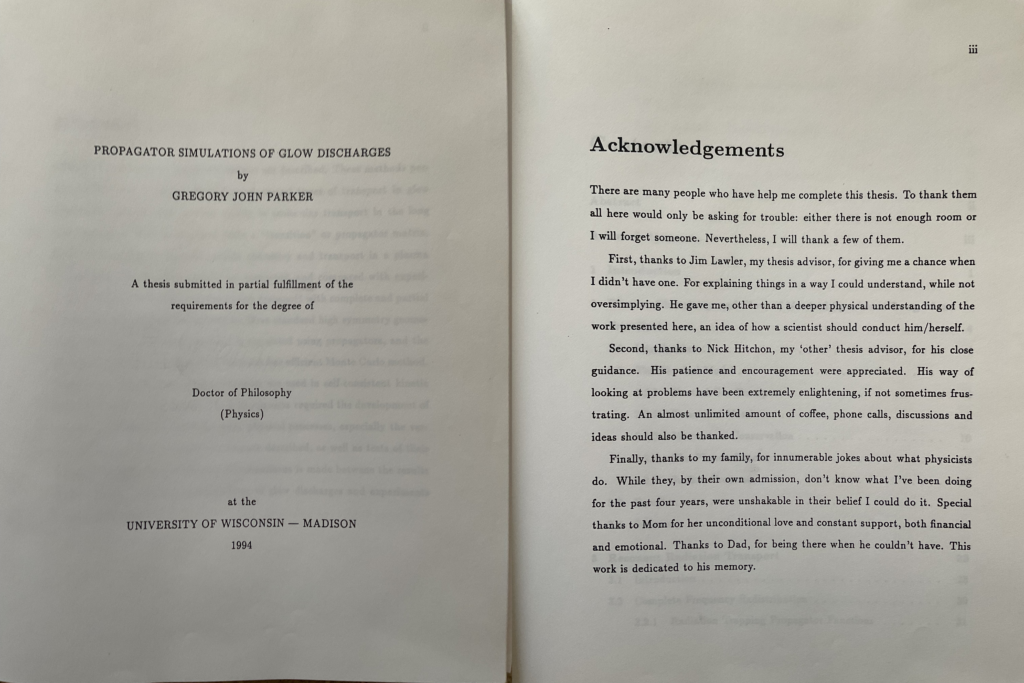
As a mental exercise, could I have said anything to change that 18 year old? What would derail myself? That is one reason I wrote this “So, you want to be a physicist?” series. But mostly to practice writing.
I’ll venture my 18 year old response:
1) making popcorn: “Ha. Coding! Basement?”
2) look! shiny! : “Sounds cool. Could work!”
3) whales and krill: “YES! I’m better than a krill.”
4) orgs : “I play chess.”
5) managers: “BF Skinner them.”
6) logic: “That logic covered in math?”
7) the price: “What IS wrong with you? Just deal with it. You’re a krill.”
So, no. An 18 year old knows little of significance. Full of common sense b.s.. No derailing. The die was cast before 5.
But now I finally know why that South Hall memory stuck. I did change. Albeit 35 years later. Solved. Unintentional.
It is a ride. One way. No refunds. No do overs. Not wasted. I think.
Cheers
(Everything written in this series was observed. It is, as they say, what really happened. It is what it is.)
Addendum:
To be honest, I didn’t know where this series was going to go until Part 4 or 5. I’ll go with Poincaré, my subconscious did. Most likely before I wrote the first word. It seems too cohesive to be simply a coincidence. I do think my writing did improve, so that was nice. It is still very difficult.
It is probably a good thing I didn’t become a writer.
Add a Comment